00 Signal

00 / Signal

Bengaluru, India
--:--:-- · GMT+05:30

Turning complexityinto clarity.

Software architect. I build multi-agent AI, data platforms and quantitative systems — and make them legible enough to operate.

Building
  • Multi-agent systems
  • Enterprise AI integration
  • Data platforms & lakes
  • Predictive models
  • Cloud architecture
  • Quantitative trading systems
  • Research infrastructure
01

The practice

Software architect · Bengaluru · Independent since 2020

Fifteen years, and the job has not really changed: someone hands me a tangle, and I hand back something a team can build.

I design and lead the delivery of platforms that have to be scalable, maintainable and actually aligned with what the business asked for. Full-stack engineering, cloud architecture, and the strategy conversations that decide which of the two you need more of.

Over time the work has grown to include machine learning and, more recently, agentic AI — not as experiments, but as tools that automate a workflow, sharpen a decision, or remove work nobody should be doing by hand. I care about integrating it responsibly: reliability, cost control, access control, and an outcome you can point at.

I have built for finance, healthcare, logistics, e-commerce and manufacturing — reconciliation for an asset manager, data governance for a card network, delivery prediction that became a patent filing, and most recently a multi-agent orchestrator running inside Microsoft Teams. Collaborative, outcome-driven, and consistently more interested in simplifying a system than in adding to it.

Diplomat by temperament. Systems architect by profession.
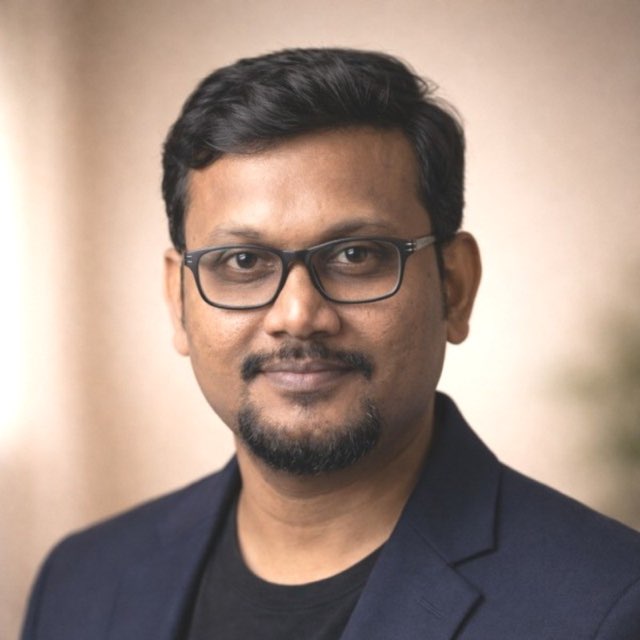
Arjun Nemical
Practice
Independent consultant
Experience
15 years · since 2011
Base
Bengaluru · GMT+05:30
Clients
15+ since 2020
Patent application
US 16/831570 · Caterpillar
Education
BE CSE · VTU 2014
Languages
Kannada · English
Hindi · Telugu
02

Instruments

Six benches — what I actually reach for, and what I have learned about each

Multi-agent orchestration, intent routing and memory — plus the older, less glamorous half: classification models that quietly remove manual work. I care most about the parts that make an agent trustworthy: role-based access, audit logging, and knowing when to hand back to a human.

  • Multi-agent orchestration
  • Intent routing
  • Memory layers
  • Boosting models
  • NLP & Lucene
  • Audit & access control

Fifteen years of shipping both halves. Java and Spring Boot on the server, Angular and React in front, Python and Node wherever they fit best — chosen for the team that has to maintain it, not for the CV.

  • Java & Spring Boot
  • Python
  • Node.js
  • Angular
  • ReactJS
  • TypeScript

Infrastructure written down rather than clicked together. Serverless where it genuinely simplifies, containers where it does not, and Terraform so that the environment is a file somebody can review.

  • AWS Lambda
  • API Gateway
  • S3
  • Microsoft Azure
  • Terraform
  • CI/CD

Modelling, migration and performance — the work that decides whether an application feels fast three years from now. Most problems described to me as AI problems turn out, on inspection, to be data problems.

  • PostgreSQL
  • MongoDB
  • MySQL & Oracle
  • Redis
  • Apache Spark
  • Hive

Systems that stay legible under load and under change. The work I am proudest of is standardising a platform so several brands ship from one codebase — and so the next feature costs a fraction of the last one.

  • Microservices
  • REST & SOAP
  • Hibernate JPA
  • Multi-brand platforms
  • Observability
  • Performance

Leading teams from requirement gathering to production, and explaining the trade-offs to whoever needs to hear them — engineers and non-technical stakeholders alike. A decision nobody can restate is a decision that will not survive.

  • Team lead
  • Agile & Waterfall
  • Code review
  • Mentoring
  • Stakeholder comms
  • Jira & Azure DevOps
04

The model

What delivery prediction looks like when you can actually see it

The ETA Predictor fused five years of freight, ocean and last-milestone history into a single arrival estimate — the work behind the patent filing. Prediction was the small half. The large half was making the result legible: a signal, a naïve baseline to beat, the excursions where the model was wrong, and the operating regimes that explain why.

Synthetic series — generated in-browser
Period
—
Model signal
—
Excursion
—
Baseline
—
Regime
—
Yearly summary of the synthetic series.
Model signalNaïve baselineExcursion from peakOperating regime

Hover, or focus the chart and use ← → (hold Shift for a faster sweep)

Synthetic yearly summary
YearChangeWorst excursion in yearEnding level
202124.2%-9.2%1.24
20224.3%-20.1%1.29
202340.2%-9.0%1.82
2024-0.9%-19.2%1.80
202518.1%-5.2%2.12
Model vs baseline
1.30×
Worst excursion
-20.1%
Signal to noise
1.34
Periods above baseline
55.1%
Series volatility
12.9%
05

Six working rules

How I work — each of these cost me something to learn
  1. Outcome-driven, not hype-driven.

    AI goes where it measurably helps — automating a workflow, sharpening a decision, removing repetitive work — and stays out of everywhere else. If I cannot name the number it moves, it is not ready to ship.

  2. Turn complexity into clarity.

    Most of what I am handed is tangled by accident rather than necessity. The job is to find the simpler system hiding inside it, and to describe that system clearly enough that a team can build it without me in the room.

  3. Explain it to the person who is not an engineer.

    A design that only survives among specialists will not survive a budget review. I have learned to carry the same explanation up and down the org chart without changing what is true about it.

  4. Standardise once, deliver many times.

    The best week I ever spent was on shared APIs, coding standards and a platform that several brands could ship from. Every feature after that was cheaper — and that compounding is the whole argument for architecture.

  5. Own it end to end.

    Requirement gathering through to production deployment, including the unglamorous middle. Handing a design over the wall is how designs quietly become something else.

  6. Leave the team more capable than the system.

    Mentoring from a project’s inception through deployment and maintenance is not a side activity. The code will be rewritten; what the team learned building it is what actually persists.

06

Log

Davangere to Bengaluru, freelance to lead and back again — 2011 to now
  1. 2011

    Freelance, from college onward

    PHP, MySQL, Java, Android, Flash and a great deal of jQuery — whatever the project needed. Four years of small clients is a fast way to learn what actually breaks in production.

    Davangere
  2. 2015

    Senior Software Engineer

    Web application development, full time, for the first time. Learning how a project behaves when more than one person is responsible for it.

    Fullerene Solutions
  3. 2016

    Into Caterpillar

    Web application development on site for Caterpillar India (CLTSI) — the engagement that turned into four years of platform work.

    Magna Infotech · Quess Corp
  4. 2016

    Lead Software Engineer

    Senior full-stack engineer and IT analyst, acting as lead. Standardised the platform so several brands could ship from one codebase, enforced coding standards, and built the shared data sources and APIs behind the apps.

    Caterpillar India
  5. 2018

    Machine learning, in production

    ETA prediction, ECCN auto-classification, spend categorisation, an NLP search layer over the incident database, and a monitor covering more than eighty applications. Leading teams of up to ten.

    Caterpillar India
  6. 2020

    Patent filed

    Systems and Methods for Predicting Machine Delivery — filed 26 March 2020, out of the delivery-prediction work.

    US 16/831570
  7. 2020

    Independent again, deliberately

    Fifteen-plus clients since: reconciliation for an asset manager, data governance for a card network, an investor platform, a payments risk dashboard, a donation platform. Architecture, delivery and the conversations in between.

    Consulting
  8. 2024

    Agentic systems

    Generative AI began as a personal obsession — agents, memory and orchestration in the lab — before it became client work: Neo, an enterprise multi-agent orchestrator with routing, memory, SSO-mapped permissions and audit logging. The interesting constraints are not model quality; they are access, cost and accountability.

    Current
07

Horizon

What I am working toward right now — and how far along it honestly is

01 / Horizon

Agentic AI that survives an audit

Most agent demos assume a trusting environment. The work now is everything that makes one deployable inside a company: role-based access, audit trails, cost ceilings, and a clear handover point back to a person.

Neo · shipped, iteratingTesting

02 / Horizon

ARIA — Autonomous Responsive Intelligent Agent

A personal research agent that runs continuously instead of waiting for prompts: competing attention daemons, durable memory that supersedes stale facts, self-authored goals, and an iterate-then-verify execution loop. The private lab where the agentic patterns I ship for clients are pressure-tested first.

Personal R&D · in buildBuilding

03 / Horizon

Architecture that outlives its authors

Turning the patterns I keep rebuilding — shared APIs, externalised configuration, multi-brand platforms — into something I can hand a team as a starting point rather than rediscover on each engagement.

Practice, not productBuilding

04 / Horizon

AI where it is measurable

Instrumentation for AI features so that reliability and cost are visible from day one, and the decision to keep or remove a feature can be made on evidence instead of enthusiasm.

In buildBuilding

07

Open channel

If you have a platform that has to hold up under real load — and real change — I’d like to hear about it.

Available for architecture, agentic AI and full-stack delivery work. Short notes beat long decks — tell me what is tangled and I will tell you honestly whether I am the right person for it.

  • Arjun’s strongest talents lie in his unique and almost uncanny ability to quickly understand a customer’s business domain and interpret the customer’s business needs into clear, concise business requirements.

    Sagar Kadadevarmath — Product Designer, Philips
  • …the go to guy when you want a new complex problem to be solved… while keeping the quality and design principles at the top of his mind. He works independently from start to end and requires absolutely no management intervention in his deliveries.

    Sridhar Reddy Kottakapu — Product Lead, SecurEnds
  • He has one of the best minds when it comes to solving complex problems and his high level understanding of them is awe inspiring.

    Rohith Raju — Principal Software Engineer, Fidelity Investments
  • He is really very smart, thorough, friendly and very easy to work with. He has tremendous amount of technical skills in multiple areas… I was particularly impressed by his multi-tasking skill that is a fabulous talent.

    Rajashekhar Ganamoni — IT Architect
me@masterarjun.com
  • AAgentic AI that has to survive access control, audit and a real budget — not another demo.
  • BPlatform architecture: the kind where several products have to ship from one codebase without anyone dreading it.
  • CTeams who want the architecture explained, not just delivered.

How an engagement runs

  • 1You’ll get options, with a bet. I bring more ways to solve it than you asked for, then tell you which one I’d stake my name on and why.
  • 2Positions move on evidence, not volume. I’ll hold an unpopular design call in a hostile room — and drop it the moment the data says I’m wrong.
  • 3If I commit, it lands. I keep few enough engagements at a time that a promise from me means the work gets finished, not started.
  • 4You’ll hear the inconvenient thing early. Fit, feasibility, cost — said plainly at the start, not discovered at the end.

Replies within one business day · GMT+05:30

Open to new engagements · Bengaluru & remote

Sound on.